
The First Casa Dei Bambini: Where Montessori Education Began
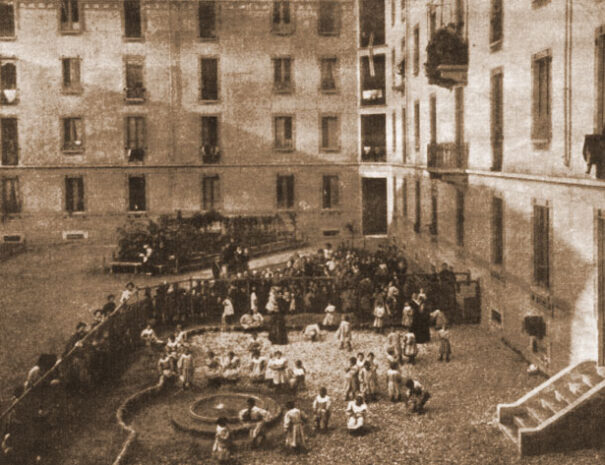
Dr. Maria Montessori opened the first Casa dei Bambini (Children’s House) on 6 January 1907 in San Lorenzo, Rome. Through her observations and work with these children she discovered their astonishing, almost effortless ability to learn. Thus began a century of great work uncovering the true nature of childhood.
Photo taken on the day of the opening of the Casa dei Bambini, 6 January 1907,
Via dei Marsi, 58, San Lorenzo, Rome, Italy.
The First Casa dei Bambini: Where Montessori Education Began
On January 6, 1907, a quiet revolution in education began in San Lorenzo, Rome, Italy. In a modest apartment complex serving working-class families, Maria Montessori opened the very first Casa dei Bambini—or Children’s House.
What started as a small community project would grow into the Montessori Method, now practiced in thousands of schools across the world and influencing early childhood education for more than a century.
Why the First Casa dei Bambini Was Revolutionary
At the time, early education was largely rigid, adult-directed, and focused on discipline rather than development. Maria Montessori—trained as a physician and deeply influenced by scientific observation—took a radically different approach.
Instead of asking “How do we teach children?” she asked:
“How do children learn?”
Inside the Casa dei Bambini in San Lorenzo, Montessori observed children carefully and designed an environment that allowed them to learn naturally, independently, and joyfully.
Key Innovations Introduced in 1907
The first Casa dei Bambini introduced principles that are now foundational to Montessori education:
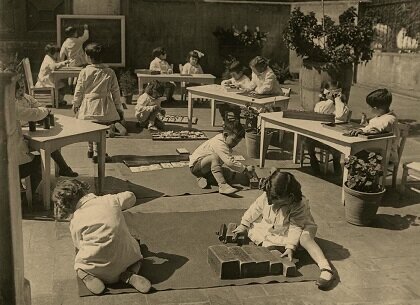
Child-Sized Environments
Furniture, tools, and materials were scaled to the child—not the adult—supporting independence and confidence.
Learning Through Movement and Choice
Children were free to choose their work, move about the classroom, and repeat activities until mastery was achieved.
Hands-On Materials
Specially designed materials helped children understand abstract concepts through concrete experience.
Respect for the Child
Perhaps most revolutionary of all, children were treated as capable individuals worthy of trust, dignity, and respect.
These ideas were groundbreaking in 1907—and remain transformative today.
From One Classroom to a Global Movement
The success of the Casa dei Bambini quickly gained international attention. Visitors from across Europe and North America traveled to Rome to observe Montessori’s work. Within a few years, Montessori schools began opening worldwide.
Today, the Montessori approach is used across:
Early childhood education
Elementary and secondary education
Special education
Home-based learning environments
All of it traces back to that first classroom in San Lorenzo.
Why This History Still Matters Today
More than a century later, the principles born in the Casa dei Bambini remain deeply relevant:
Children thrive when trusted with responsibility
Well-prepared environments reduce behavioral challenges
Independence builds confidence and lifelong learning skills
At Butterfli Software, we draw inspiration from these same principles—designing systems that respect educators, support independence, and simplify complex administrative work, so schools can focus on what matters most: the child.
Montessori’s Legacy and the Future of Education
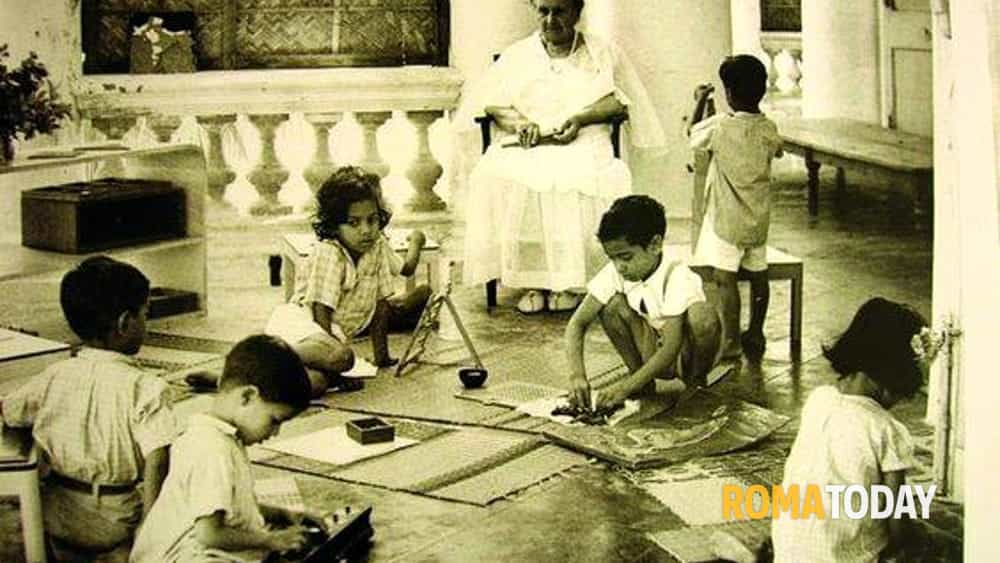
Maria Montessori’s work in 1907 was not just the founding of a school—it was the beginning of a new way of understanding childhood. The Casa dei Bambini showed the world that when children are given freedom within structure, incredible growth follows.
As Montessori educators and school leaders continue this work today, the spirit of that first classroom in Rome lives on—in every prepared environment, every carefully observed child, and every moment of joyful discovery.
Final Thoughts
From a single classroom in San Lorenzo to a global educational movement, the first Casa dei Bambini reminds us that lasting change often begins quietly—with observation, respect, and trust in human potential.